Under construction!
Ruins, Walls, and Area Terrain
The Leviathan Tournament Companion provides set patterns of terrain as well as a key to what terrain should be used, its heights, and what kinds of profiles it might have (LTC, 4). These are not requirements, but merely suggestions, though the majority of tournament organisers tend to observe the layouts provided. Each layout also corresponds to certain lettered missions to prevent unwieldy interactions between terrain and objectives, for instance.
A key distinction should be made with reference to the layouts provided. First, Games Workshop has provided two different colors and outlines corresponding to different suggested kinds of terrain: Ruins and “Area Terrain” (LTC, 4-6).
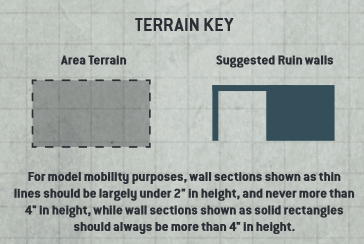
As seen above, the dashed outlines are supposed to be roughly 2″ in height or so and no more than 4″ (LTC, 4). On the other hand, the solid outlines should represent ruins proper. Judging by their suggestion that “robust” collections of terrain that grant actual line of sight blocking may supersede using Ruins (ostensibly due to the artificial Obscuring property of Ruins), line of sight blocking is the main motivator underlying the kinds of terrain and the density suggested in the LTC.
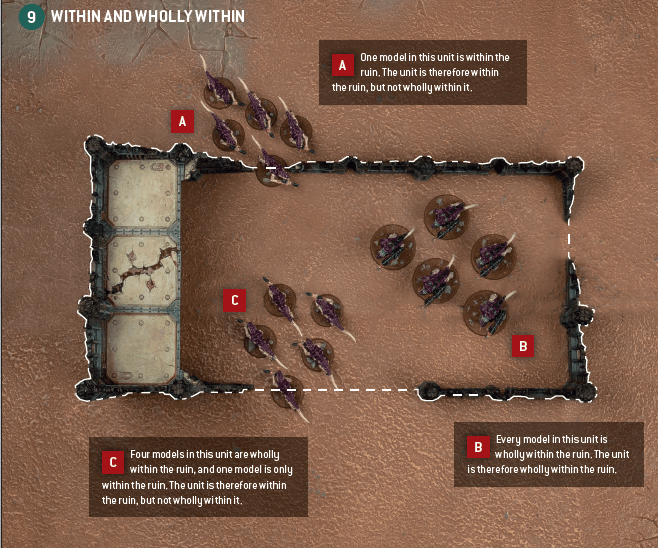
This is most important when it affects visibility in and around ruins. There are essentially a sequence of rules that must be checked:
1. Is either a ruin (the actual terrain item) or an area terrain (aka the “footprint” of the feature, or the grey shape provided in the Tournament Companion) between the base of the attacker and the base of the defender? If so, then the defending unit is not visible. This is the case for the infantry group A and the Vehicle pictured below. Note also that if a vehicle lacks a base, its hull (outermost points of the body’s armour panels) is considered to be the “base” for all rules purposes discussed here.
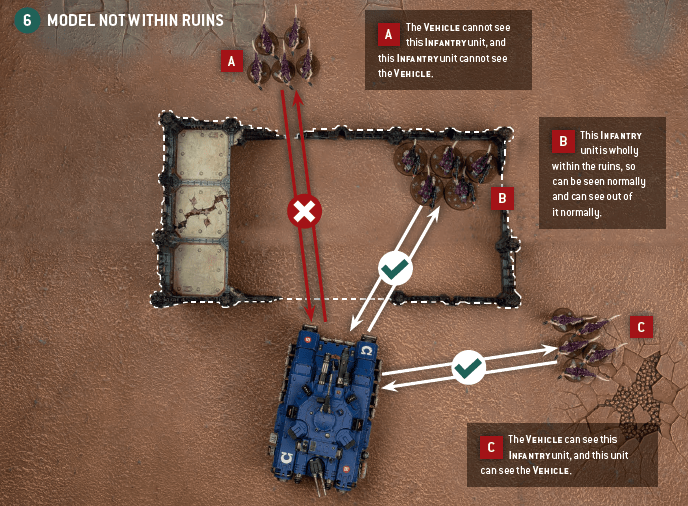
2. If either a ruin (the actual terrain item) or an area terrain (aka the “footprint” of the feature, or the grey shape provided in the Tournament Companion) is between the base of the attacker and part of the base of the defender (aka the defender is partially within the terrain), then the attacker may shoot the defender. This is the case in Rules Commentary Image 7 (below) for the termagants (A) attacking the vehicle (B).
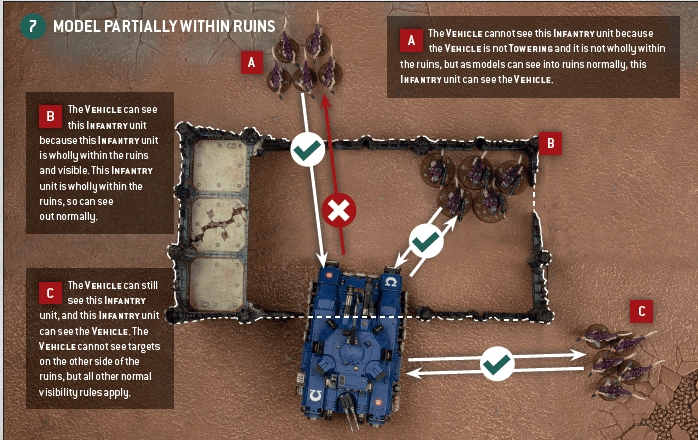
3. If, an attacking model has part (and only part) of its base in a terrain fixture, whether it can shoot depends on which “wall” it is in. In Rules Commentary Image 7 above, there is the “far wall” (the one the vehicle is not in contact with) and the wall that the vehicle is sitting atop/crossing over. If an enemy is on the outside of the far wall, it is not an eligible target for the vehicle partially within the ruin. However, if an enemy is on the inside of the far wall (and therefore no walls or boundaries of area terrain are actually between it and the attacker) it is an eligible target. See the differences for the attacking vehicle for the termagants labeled A and B. Similarly, if there are no walls or boundaries of area terrain between the part of a vehicle that is outside of a ruin and the enemy, the vehicle can target that enemy. In short, always keep in mind whether a wall (or the boundary of a footprint/area terrain) is between the model partly in the ruin and its intended target. The model partially within the terrain feature cannot shoot through a wall, but it does not matter if it is itself partly in a terrain feature otherwise (and doing so can give the model access to targets wholly within the feature).
Just remember: the same does not apply for a model wholly outside of a feature targeting a model partly within a feature. Although it is highly illogical, if a model outside of a ruin (beyond the “far wall”) is shooting a model that is partially within an area terrain feature, it is able to do so, though the reverse is not true.
Complicating this further is the idea of “first floor closed” (or “ground floor closed”). This means that walls forming ruins, regardless of how they are modeled (aka with breaks and/or windows) are treated as solid masses, unable to be shot through (either from inside to out or vice versa). This has been the norm for the majority of 10th Edition play, and it has been asserted that it is a Games Workshop ruling. However, this is not currently able to be confirmed. It does seem to be both ITC and WTC policy, however.
- Can models with the “Swarm” keyword go through Ruins?
The Verdict: No. Only models that have the “Infantry” or “Beast” keywords “can move through this terrain feature (walls, floors, ceilings, gantries, chains, etc.) as if it were not there” (CR, 48). This seems as though it was an oversight on the part of the rules’ authors; even if it was, it has not been corrected in several Balance Dataslates, and must be considered both Rules as Written and Rules as Intended as of 03/2024.
No independent organizations’ FAQs have been found to contradict this as of 03/2024.
 Lawyer of Rules, LLC